
APQP (Advanced Product Quality Planning)
Practical Guide to the 5 Phases, Deliverables, and Core Tools
Advanced Product Quality Planning (APQP) is a structured product and process development methodology used to ensure that new products meet customer requirements reliably, predictably, and with minimized launch risk. APQP is widely required in automotive and other regulated supply chains. Its core value lies in planning and evidence-based phase gates that drive quality from requirements to production readiness.
APQP consists of five phases:
Plan & Define Program
Product Design & Development
Process Design & Development
Product & Process Validation
Launch, Feedback, Assessment, Corrective Action
APQP works in tandem with other quality tools — especially DFMEA/PFMEA, Control Plans, Measurement System Analysis (MSA), Statistical Process Control (SPC), and Production Part Approval Process (PPAP). These “Core Tools” are not separate checkboxes but integrated evidence of risk management and control.
1) What is APQP, and what it is not?
APQP is not generic project management. It is a quality planning framework with clear deliverables, cross-functional ownership, risk controls, and gated phase exits. Its purpose is to ensure products are designed and manufactured right the first time while meeting customer expectations. The structured approach forces early risk identification and mitigation, avoids late changes, and formally demonstrates readiness before production.
Unlike general project plans or traditional waterfall product planning, APQP places emphasis on quality risk control and traceability at every stage. It aligns engineering, manufacturing, purchasing, quality, and supplier teams through documented evidence, not just status meetings.
APQP is often mandated contractually by OEMs and prime contractors in automotive, aerospace, heavy equipment, and other regulated industries due to its proven effectiveness in reducing defects, recalls, and warranty costs.
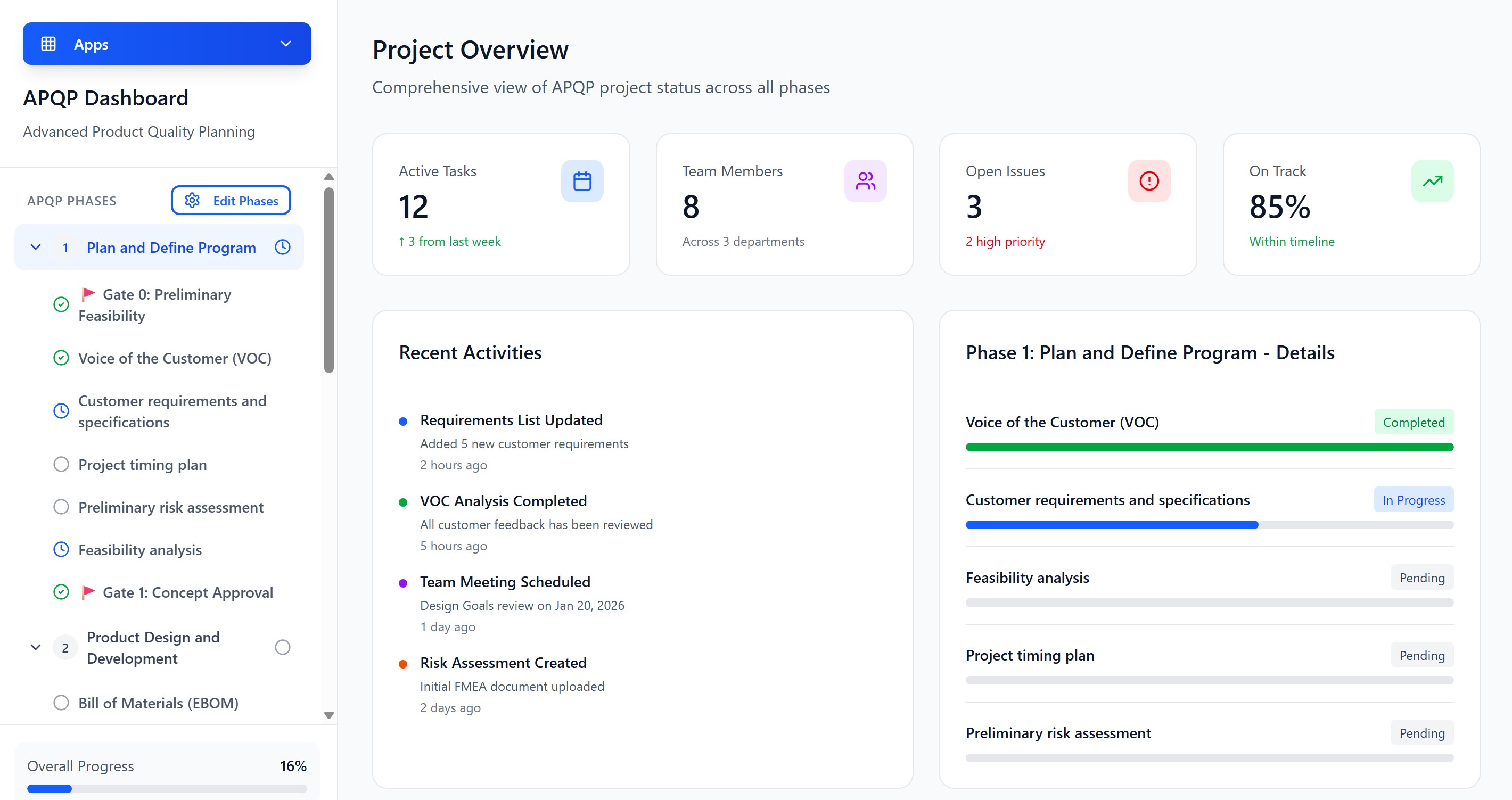
APQP software like project flow can help streamline the collaborative effort and structure the project.
2) Standards and Reference Ecosystem
The authoritative reference for APQP in automotive is the AIAG APQP manual (latest third edition). It provides detailed phase descriptions, deliverables, sample control plans, and guidance on integrating Core Tools. Organizations implement APQP to comply with customer expectations and to support compliance with quality system standards like IATF 16949.
APQP is not a standalone quality system; it ties into management system requirements by providing evidentiary documentation for design and process controls, risk assessment, and change management. Customer-specific requirements (CSRs) further tailor APQP expectations for particular OEMs.
3) APQP Governance Model
APQP must be governed — otherwise it becomes paperwork with little value. Critical governance elements include:
Cross-Functional Team Structure
Product development, process engineering, quality, manufacturing, purchasing, and supply quality must be jointly responsible. Ownership is explicitly assigned for deliverables.
Gated Milestones
Each phase has clear criteria to “exit” the phase: documented review, closed risks above a threshold, approved prototypes, or validated controls. These gates prevent premature transition to the next phase.
Metrics
Planned vs actual schedules, open risks, issue closure rates, effectiveness of corrective actions, prototype test outcomes, capability results, and customer sign-offs are the core metrics.
Change Control
Changes to design or process must flow through formal revision management with impact analysis and traceability to requirements or risk items.
4) The 5 APQP Phases
Phase 1 — Plan & Define Program
Objective: Understand what the customer requires and whether the organization can deliver.
Key Activities: Capture voice of customer, translate it into clear requirements, perform feasibility analysis, create preliminary product architecture and high-level process strategy.
Deliverables: Requirement specifications, preliminary risk list, project plan, initial high-level Bill of Materials (BOM), supplier strategy.
This phase reduces ambiguity early. Poor planning here is the root cause of late design changes and cost overruns.
Phase 2 — Product Design & Development
Objective: Develop a design that meets requirements reliably.
Key Activities: Engineering design, design reviews, prototype planning, design risk assessments (DFMEA), definition of special characteristics, documentation of design verification methods.
Deliverables: Final design documents, DFMEA with risk mitigations, prototype test plans, updated BOM, special characteristic definitions.
This is where the product’s technical blueprint is solidified and validated incrementally.
Phase 3 — Process Design & Development
Objective: Translate the design into an efficient and controlled manufacturing process.
Key Activities: Process flow chart creation, PFMEA, control plan drafting, tooling and equipment planning, measurement system planning, work instructions creation.
Deliverables: Process flow diagrams, PFMEA with action plans, detailed control plans, tooling requirements, measurement plans.
This phase ensures the manufacturing process can consistently produce quality parts before heavy investment in full production.
Phase 4 — Product & Process Validation
Objective: Prove that processes and product designs are stable, capable, and ready for production.
Key Activities: Pilot builds, capability studies (process and measurement), final MSA, pre-launch reviews, preparation of PPAP submission packages.
Deliverables: Capability reports, measurement system validation, final control plans, PPAP documentation, launch readiness assessment.
Validation is not an optional check — it’s evidence that quality is predictable.
Phase 5 — Launch, Feedback, Assessment, Corrective Action
Objective: Introduce product into production and capture early performance feedback.
Key Activities: Controlled launch, early containment if needed, customer feedback, corrective action processes, continuous improvement updates to FMEAs and control plans.
Deliverables: Launch performance data, corrective action records, updated risk control documents, lessons learned.
This phase ensures problems discovered during launch don’t escalate into full production issues.
5) How Core Tools Integrate Within APQP
APQP uses the Core Tools as evidence and risk control mechanisms:
DFMEA (Design FMEA) identifies potential design risks; mitigations flow into design decisions.
PFMEA (Process FMEA) identifies manufacturing risks; mitigations are built into control plans.
Control Plans document how each process step is monitored and controlled.
MSA (Measurement System Analysis) validates that measurements used for control are reliable.
SPC (Statistical Process Control) tracks process stability and capability post-validation.
PPAP (Production Part Approval Process) formalizes submission of evidence that design and process are controlled and capable.
These tools are not isolated; a robust APQP program orchestrates them across phases.
6) Evidence, Documentation, and Audits
Customers and auditors look for traceable evidence. They sample phase exit reviews, risk assessment documents, control plans tied back to design requirements, and change control logs. Typical gaps include incomplete risk closure, missing validation evidence, and lack of connection between FMEAs and control plans.
To prevent findings, organizations should maintain traceability matrices, clear owner assignments, and documented reviews at each gate.
7) APQP Beyond Automotive
Although APQP originated in automotive, its principles are used in aerospace, heavy equipment, electronics, and other sectors that require controlled product development with measurable evidence of risk mitigation and readiness.
Adaptations focus on domain-specific tools, nomenclature, and regulatory expectations, but the basic build → validate → control philosophy remains.
8) Templates and Minimum Viable APQP Starter Kit
To implement APQP without overwhelming teams, use lightweight templates:
Phase-Gate Checklist – Clear yes/no criteria to exit a phase
Deliverables Matrix – Document list, owner, status, and evidence link
KPIs Dashboard – Schedule variance, open critical risks, capability results
Start with the basics and grow documentation as maturity increases. The goal is not paperwork — it’s predictable quality.
9) APQP Training — Building Real Capability (Not Just Compliance)
APQP only works if teams understand why each activity exists and how the deliverables connect. Many organizations fail not because APQP is flawed, but because training is superficial or siloed.
Who needs APQP training
Product and design engineers (requirements, DFMEA, design reviews)
Manufacturing and process engineers (process flow, PFMEA, control plans)
Quality engineers (Core Tools integration, validation, PPAP)
Project managers and program leads (gates, governance, change control)
Supplier quality engineers (APQP rollout and supplier readiness)
Typical APQP training levels
Foundation level: APQP overview, 5 phases, roles, and deliverables
Practitioner level: Hands-on DFMEA/PFMEA, control plans, PPAP strategy
Advanced level: Risk-based thinking, metrics, change management, complex launches, supplier APQP
Common training mistakes
Teaching tools in isolation (FMEA course with no APQP context)
One-time training with no application to real projects
No link between training examples and company-specific processes or customer requirements
What effective APQP training looks like
End-to-end case study following one product through all 5 phases
Explicit linkage between requirements → FMEA → control plan → validation
Real deliverables, not theory slides
Emphasis on decision-making, not form-filling
Well-trained teams use APQP proactively. Poorly trained teams treat it as a checklist after decisions are already made.
10) APQP Software — From Documents to Connected Systems
APQP was historically executed with spreadsheets, documents, and shared folders. This approach does not scale well for complex products, global teams, or supplier networks. Modern APQP increasingly relies on dedicated software.
Why spreadsheets fail at scale
No real traceability between requirements, risks, and controls
Version conflicts and manual updates
Weak change impact analysis
Poor visibility of program health and open risks
What APQP software by Excedify support with
Project and phase management: Clear phase gates, ownership, status tracking
Requirements management: Structured VOC, requirement flowdown, traceability
FMEA management: Linked DFMEA and PFMEA with action tracking
Control plans: Directly derived from PFMEA, not copied manually
Validation evidence: MSA, capability, test results linked to characteristics
PPAP readiness: Centralized evidence packages and approval tracking
Change management: Impact analysis across design, process, and controls
Dashboards: Risk exposure, launch readiness, overdue actions
Key advantage of integrated APQP software
The main value is connection, not automation. When a requirement changes, the software should immediately show:
Which DFMEA items are impacted
Which process steps and control plan elements are affected
What validation must be repeated
This turns APQP from static documentation into a living system.
Implementation reality
Software does not replace APQP knowledge — it amplifies it
Start simple: one project, core modules, clear ownership
Avoid “tool overload”; maturity matters more than features
Organizations that combine solid APQP training with well-implemented APQP software consistently outperform those relying on documents and tribal knowledge alone.